

Money, love, and care in Thailand are more often intertwined

In discussions about Thai relationships with Western men, money often immediately takes center stage. This usually happens in a simplistic way. Outsiders are quick to jump to conclusions and view financial support as proof of insincerity, dependence, or calculation. However, a closer look at the Thai context reveals that love, care, family responsibility, and money intertwine much more frequently than is common in the Netherlands or Belgium.
Precisely for this reason, this subject calls for nuance. Not every relationship works the same way, and not every flow of money means the same thing. Age, region, education, income, children, family ties, and stage of life make a significant difference. Based on recent Thai figures, academic research, and practical experience, patterns can indeed be recognized. These show why money is given, where it actually goes in practice, and which monthly amounts are often perceived as low, average, or high.
Why Western men give money to their Thai partners
In practice, the motives are almost always mixed. In some relationships, financial support is primarily a logical consequence of living together. Whoever earns more pays more. You see this not only in Thailand, but everywhere. In other cases, it concerns care and responsibility. A partner helps with rent, groceries, medical expenses, school fees for children, or supporting parents. Especially in the case of a long-distance relationship, money is sometimes seen as a way to show involvement and provide stability.
At the same time, other factors also play a role. Some men feel appreciated, needed, or emotionally valued in a relationship where they have a clear caregiving role. Sometimes there is a need for companionship, domesticity, loyalty, or a less individualistic form of relationship than they know from their own country. Additionally, there are situations in which status, a need for control, or the desire to secure affection play a part. This does not automatically make financial support suspect, but it does mean that love, care, and power cannot always be neatly separated.
The Thai context of family, duty, and mutual care
Anyone who views the subject solely through a Western lens misses an important part of reality. In Thailand, family support is often a normal and morally embedded part of adulthood. Many children feel responsible for their parents, especially when they have little pension, no longer receive a stable income, or are dependent on care. That support is not always substantial, but it is structural. It involves money, but also transportation, medical assistance, groceries, administration, and daily presence.
For many Dutch and Belgians, a partner relationship is more strongly characterized by two individuals who are financially independent or, at least, view their relationship as separate from broader family obligations. In Thailand, these aspects are more often intertwined. A relationship with a Thai partner can therefore also mean that you indirectly have to deal with parents, children, grandparents, or other family members. This does not necessarily have to be a sign of abuse. It is often part of a social system in which family still forms an important safety net, precisely because the state offers less support than in Western Europe.
Is financial support love, partner support, or buying affection?
That depends entirely on the relationship. Financial support is not in itself proof that someone is buying love. In many relationships, it is simply partner support. This is certainly true when there is openness regarding income, expenses, family obligations, and expectations. When two people share a household, help each other during illness, or contribute to the care of parents or children, money is primarily a practical component of connection and mutual care.
But there are also less healthy forms. When money becomes a condition for attention, loyalty, or access to the relationship, it shifts towards an economic arrangement. And if one partner no longer feels the true freedom to say no, reciprocity disappears. Then dependency or emotional pressure comes into play. The honest answer, therefore, is that financial support *can* be love, but also care, duty, negotiation, or in some cases, a form of purchased closeness. You can only make that assessment based on behavior, transparency, and power dynamics, not solely on the fact that money is given.
What the money is usually used for in practice
A persistent stereotype is that money is primarily spent on luxury, going out, or superficial consumption. That view is too simplistic. Research into money flows within Thai households shows that extra income is often spent on health, education, household expenses, and sustainable spending. In practice, therefore, financial support from a Western partner often goes to very ordinary and recognizable categories.
Think of groceries, rent, electricity, water, internet, petrol, telephone, clothing, and transport. In addition, medical expenses, school costs for children, contributions to parents, home maintenance, or debt repayment often play a role. In a rural environment, for example, support may be needed to help parents who have a small pension. In an urban context such as Bangkok, Pattaya, Chiang Mai, or Phuket, it tends to shift towards rent, transport, school, and healthcare. Sometimes a portion of the money goes towards savings or emergency expenses, but due to the high pressure of everyday costs, there is by no means always much left over.
What is often meant by supporting family in Thailand
For many Westerners, supporting family quickly sounds as if one partner has to support the entire family. In practice, the situation is more nuanced. Usually, it involves recurring support for parents, help for children from a previous relationship, a contribution during illness, costs for school or transportation, and sometimes a temporary gap in the household budget of family members. It therefore often involves multiple small and concrete obligations, not automatically an endless flow of money to a large clan.
That does not alter the fact that expectations from the family may exist. Especially if a daughter is in a relationship with a foreign man, the idea may arise in some families that there is more financial leeway. This is a sensitive point. For what is normal parental care for the Thai partner can feel like social pressure to the Western partner. The difference often lies not in the facts, but in the cultural interpretation. In Thailand, family help can feel morally self-evident, whereas a Dutch or Belgian person is quicker to view it as something to which limits must be set.
Which monthly amounts are common in practice
There is much confusion regarding this part of the subject, particularly because there is no large, representative Thai survey that precisely measures what Western men give to their Thai partners. Therefore, one must make a clear distinction between hard data, derived estimates, and anecdotal experience. The hardest foundation lies in Thai wages, expenses, and cost of living. This shows that a contribution of a few thousand baht can already be substantial, certainly outside Bangkok and outside the more expensive tourist zones.
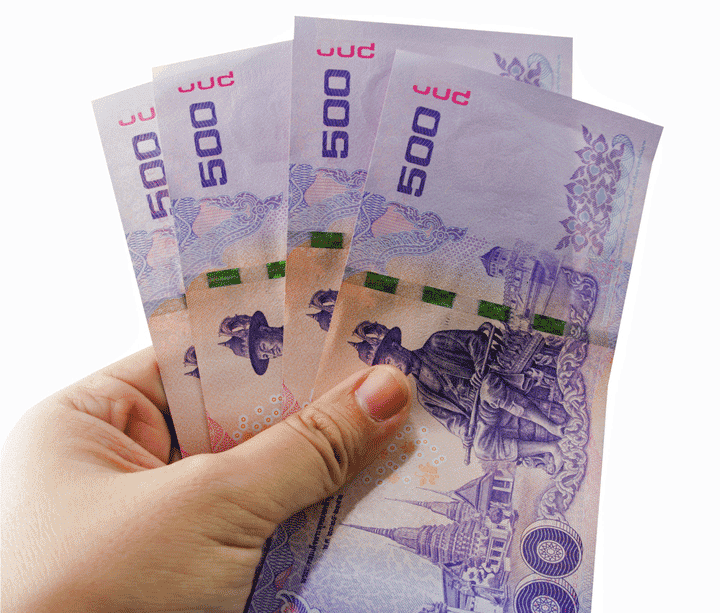
Giving 3000 to 7000 baht per month often involves limited support for parents or a modest supplement to a partner's income. Around 5000 to 15.000 baht, you are more likely to find yourself in a long-distance relationship or with a partner who still earns an income but receives support for daily expenses. Between 10.000 and 20.000 baht, it usually concerns structural help that makes a visible difference in daily life. From 20.000 to 30.000 baht, you often finance a large part of a household, especially outside the major cities. In urban situations, including children, rent, transport, and elderly care, amounts can rise to 25.000 to 50.000 baht or more.

Comparison table of common monthly amounts
| Context | Standard monthly support | Clarification |
|---|---|---|
| Help only for parents in the province | 3.000 to 7.000 baht | Modest but meaningful contribution |
| Partner lives separately and has their own income | 5.000 to 10.000 baht | Supplement to basic charges |
| Long-distance relationship with limited housing costs | 5.000 to 15.000 baht | Often for living expenses, telephone, transport, and family assistance |
| Partner in Thailand with low or irregular income | 10.000 to 20.000 baht | Structural support, often a significant part of the monthly budget |
| Living together outside Bangkok | 15.000 to 30.000 baht | Large contribution to household |
| Living together in an urban context | 20.000 to 35.000 baht | Rent, transport, and daily expenses are higher |
| Partner with children or care for parents | 25.000 to 50.000 baht or more | Full-fledged household support with additional obligations |
This table is not a strict national standard, but a realistic range based on Thai wage and expenditure figures, combined with practical experience. Therefore, such amounts should be interpreted as indicative, not as a fixed rule.
Checklist for those who want to assess this subject objectively
Use this checklist to better understand what financial support in a relationship really means:
- Is it clear where the money is going?
- Is there openness regarding income, expenses, debts, and family obligations?
- Does your partner also have their own income or other sources of support?
- Does this concern temporary assistance or structural subsistence?
- Is the money used for daily expenses, children, parents, healthcare, or debts?
- Are the family's expectations concrete and open to discussion?
- Can you set boundaries without arguments, guilt, or emotional pressure?
- Does the relationship feel reciprocal, even if the financial balance is uneven?
- Is there trust and freedom of choice on both sides?
- Does the amount fit the local cost of living and your own financial capacity?
Anyone who does not have a clear answer on multiple points is usually not so much dealing with a question of money, but with a question of trust. And that is often more important than the exact amount.
Misunderstandings that stubbornly persist
One of the biggest misconceptions is that every Thai woman who asks for support is after money. There is no basis for that. Equally incorrect is the idea that any financial support is automatically loving and normal. The reality lies somewhere in between. Some relationships are warm, stable, and reciprocal. Others are fragile, skewed, or heavily dependent on money. Anyone who lumps everything together sees their own prejudices confirmed above all.
The idea that family support is something unfair or excessive is also not entirely correct. In Thailand, it is often an ingrained social responsibility. What feels like an extra burden to a Dutch person often feels like a natural part of taking good care of the people who raised her to a Thai partner. This calls not for moral condemnation, but for clear agreements, understanding of the context, and above all, realism about what you are and are not willing to bear.
Anyone who takes this subject seriously will see that financial support for a Thai partner does not fit into a single category. It can be love, care, responsibility, practical help, social duty, or an economic arrangement. Sometimes all these things overlap simultaneously. That is why quick judgments rarely work. The core question is not only whether money is given, but above all what that money means within the relationship, how open both partners are about it, and whether the bond remains intact even without financial pressure.
Sources: National Statistical Office of Thailand, Bank of Thailand, Department of Older Persons Thailand, Journal of Population and Social Studies, Mekong-Salween Civilization Studies Journal, Reuters
About this blogger

-
This article has been written and reviewed by the editorial team. The content is based on the author's personal experiences, opinions, and independent research. Where relevant, ChatGPT was used as a tool for writing and structuring text. We also sometimes generate photos using AI. Although the content is handled with care, it cannot be guaranteed that all information is complete, up-to-date, or error-free.
The reader is responsible for the use of the information on this website. The author accepts no liability for any damage or consequences resulting from the use of the information provided.
Read the latest articles here
 Expats and retireesApril 18, 2026Dying in Thailand without a will leads to complicated inheritance issues.
 Expats and retireesApril 18, 2026Why solar panels on your home in the Thai countryside give you more freedom (video)
 Money and financeApril 18, 2026Money, love, and care in Thailand are more often intertwined
 BackgroundApril 18, 2026Kathoey in Thailand more visible than really equal